
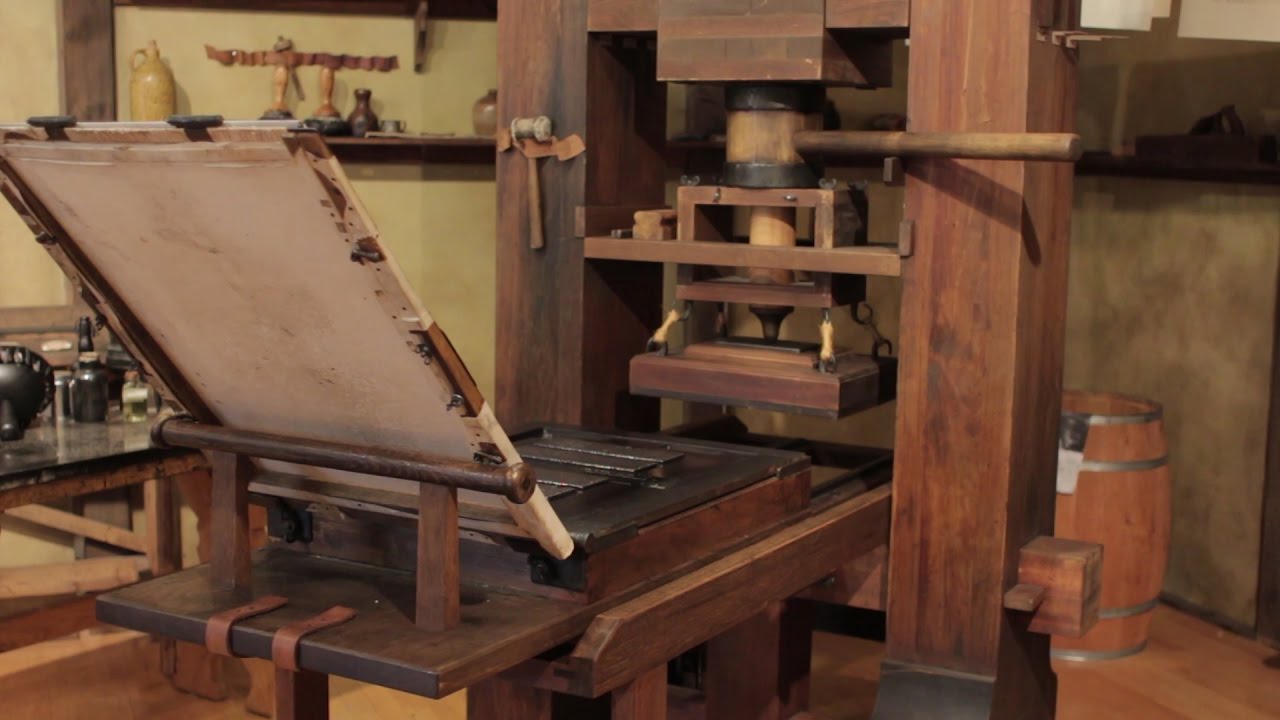
The Machine That Democratized Knowledge
In the mid-15th century, a German goldsmith named Johannes Gutenberg invented a device that would change the course of human history: the movable-type printing press. Before Gutenberg, books were painstakingly copied by hand, making them expensive and rare. His invention made books affordable and accessible, fueling the Renaissance, Reformation, and scientific revolution. The printing press didn’t just spread information—it democratized knowledge, reshaping society, politics, and culture forever.
1. The Origins of Printing
Printing wasn’t entirely new when Gutenberg perfected his press. Woodblock printing had been used in China since the 9th century, and Koreans developed movable metal type in the 13th century. However, Gutenberg’s innovation was the first practical and efficient system in Europe, combining movable type, oil-based ink, and a screw press to create high-quality, mass-produced books.
- Early Printing in Asia:
- Bi Sheng (990–1051 CE) invented movable clay type in China during the Song Dynasty, but the fragility of clay limited its spread.
- Korean printers later used metal type in the 13th century, producing texts like the “Jikji” (1377), the oldest known metal-print book.
- However, geographical and cultural barriers prevented these techniques from reaching Europe until Gutenberg’s time.
- Gutenberg’s Breakthrough:
- Gutenberg, a goldsmith from Mainz, Germany, adapted wine and olive presses to create a mechanical printing system.
- His key innovations included:
- Movable metal type: Durable, reusable letters that could be arranged and rearranged for different pages.
- Oil-based ink: Stuck to metal type better than water-based ink used in woodblock printing.
- Screw press: Applied even pressure to print sharp, clear text on paper or vellum.
- His first major project was the Gutenberg Bible (1455), a 42-line Latin Bible that became the first mass-produced book in the West.
Tip: Visit the Gutenberg Museum in Mainz to see a replica of his original press and early printed works.
2. The Gutenberg Bible: A Masterpiece of Early Printing
The Gutenberg Bible (also called the 42-line Bible or Mazarin Bible) was Gutenberg’s magnum opus and the first major book printed with movable type in Europe. Only about 180 copies were made, with 48 surviving today—most in libraries and museums.
- Production and Design:
- The Bible was printed on vellum and paper, with 1,282 pages divided into two volumes.
- It featured Gothic typeface, rubricated letters (red ink for headings), and illuminated decorations added by hand after printing.
- The text was the Latin Vulgate, the standard Bible of the medieval church.
- Impact and Legacy:
- The Gutenberg Bible proved the viability of movable-type printing, leading to the spread of printed books across Europe.
- It standardized the appearance of books, making them more uniform and accessible.
- Today, a single copy can sell for millions at auction, reflecting its historical and cultural value.
Tip: View a Gutenberg Bible at the Library of Congress or the British Library to appreciate its craftsmanship and historical significance.
3. The Spread of Printing and Its Cultural Impact
Gutenberg’s press spread rapidly across Europe, transforming communication, education, and power structures. Within 50 years of his invention, printing presses were operating in over 200 European cities, producing millions of books.
- The Printing Revolution:
- Venice became the printing capital of Europe, with Aldus Manutius pioneering small, affordable books (octavos) and italic type.
- William Caxton brought the press to England in 1476, printing the first English book, “The Recuyell of the Historyes of Troye.”
- By 1500, over 20 million books had been printed in Europe, outnumbering all manuscripts produced since the fall of Rome.
- The Renaissance and Humanism:
- Printing fueled the Renaissance by spreading classical texts (e.g., works of Plato, Aristotle, and Cicero) and humanist ideas.
- Erasmus, Luther, and other reformers used the press to challenge the church and promote new ideas.
- The dissemination of knowledge broke the monopoly of the clergy and aristocracy on learning.
- The Reformation:
- Martin Luther’s 95 Theses (1517) was printed and distributed widely, sparking the Protestant Reformation.
- The press allowed reformation ideas to spread rapidly, challenging the Catholic Church’s authority.
- Bibles in vernacular languages (e.g., Luther’s German Bible, 1534) made scripture accessible to the masses, undermining Latin as the language of religion.
Tip: Explore Luther’s 95 Theses at the Wittenberg Castle Church to see how printing amplified religious dissent.
4. The Printing Press and Scientific Progress
The printing press was crucial to the Scientific Revolution, enabling the rapid dissemination of discoveries and collaboration among scientists.
- Scientific Journals:
- The first scientific journals (e.g., “Philosophical Transactions of the Royal Society”, 1665) standardized the sharing of research.
- Isaac Newton’s “Principia Mathematica” (1687) and Galileo’s “Star Messenger” (1610) were printed and circulated, accelerating scientific progress.
- Maps and Exploration:
- Printed maps and atlases (e.g., Mercator’s 1569 world map) aided navigation and global exploration.
- Ptolemy’s “Geography” (reprinted in 1477) revived ancient cartography, influencing Columbus and other explorers.
- Encyclopedias and Dictionaries:
- The Encyclopédie (1751–1772), edited by Diderot and d’Alembert, spread Enlightenment ideas across Europe.
- Samuel Johnson’s “Dictionary of the English Language” (1755) standardized English spelling and usage.
Tip: Visit the British Library’s “Treasures Gallery” to see early printed scientific works.
5. The Printing Press in the Modern World
Gutenberg’s invention laid the foundation for modern media, from newspapers to the internet. Its principles of mass communication and democratized knowledge continue to shape society, politics, and technology.
- Newspapers and Mass Media:
- The first newspapers (e.g., “Relation”, Strasbourg, 1605) spread news rapidly, shaping public opinion.
- Freedom of the press became a cornerstone of democracy, with figures like Benjamin Franklin using printing to promote revolutionary ideas.
- Industrialization and Education:
- The 19th-century printing press (e.g., steam-powered rotary press) enabled mass production of books, newspapers, and magazines.
- Public education expanded as affordable textbooks became widely available.
- Literacy rates rose, and universal education became a global goal.
- Digital Printing and the Internet:
- Xerography (1938) and laser printing (1960s) revolutionized office and home printing.
- The internet and e-books are the digital descendants of Gutenberg’s press, democratizing information on a global scale.
Tip: Compare Gutenberg’s press with modern 3D printing to see how technology continues to evolve.
The Press That Changed the World
Johannes Gutenberg’s printing press was more than a machine—it was a catalyst for cultural, political, and scientific revolutions. By making books affordable and accessible, it broke the monopoly on knowledge, fueled the Renaissance and Reformation, and laid the groundwork for modern media. Today, as we navigate the digital age, Gutenberg’s legacy reminds us that innovation in communication can reshape societies and empower individuals. His invention proves that a single idea, when shared widely, can change the world.